Traderfx
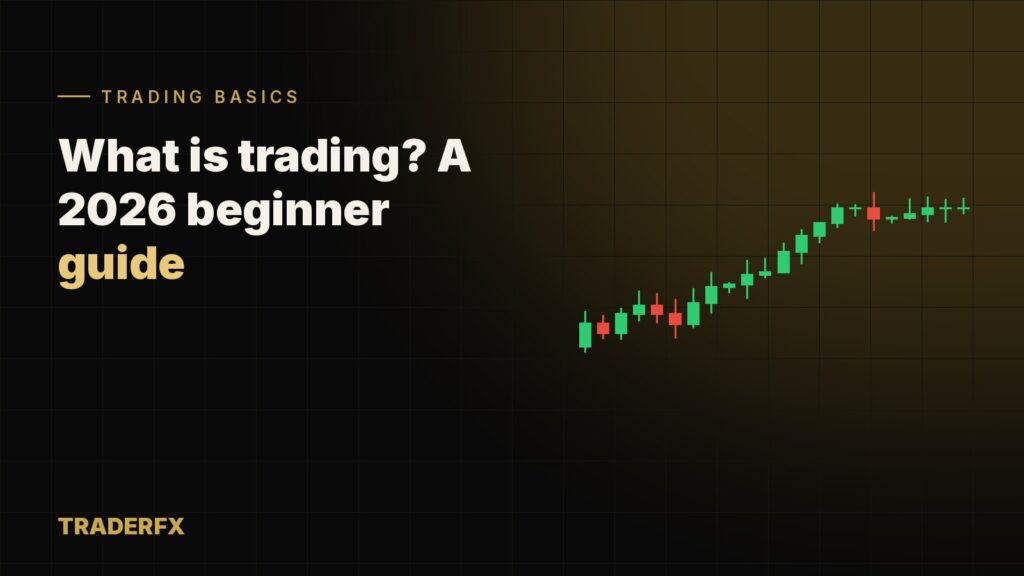
- Trading means buying and selling an asset to profit from price changes over a short to medium time frame.
- The foreign-exchange market is the largest in the world, with about $9.6 trillion traded per day (BIS, April 2025).
- Every successful trader relies on the same five building blocks: market, strategy, risk, journal and psychology.
What is trading? In simple terms, trading is the act of buying and selling financial assets — currencies, gold, stocks, indices or cryptocurrencies — with the goal of profiting from changes in their price. Unlike long-term investing, where you might hold an asset for years, a trader usually holds a position for minutes, hours, days or a few weeks.
Trading has never been more accessible. A smartphone and a small deposit are enough to open an account and place your first order. That accessibility is both an opportunity and a trap: it is easy to start, but hard to become consistent. This guide explains how trading works in plain English, which markets beginners can access, the different styles of trading, and what you need in place before you risk real money.
Trading vs. investing: what’s the difference?
Both aim to grow capital, but they use different tools, time horizons and mindsets.
| Trading | Investing | |
|---|---|---|
| Holding period | Minutes to weeks | Months to decades |
| Main driver | Price movement | Business or asset value |
| Analysis | Mostly technical (charts) | Mostly fundamental |
| Direction | Can profit from rising and falling prices | Usually profits from rising prices |
| Time needed | Regular attention during sessions | Periodic review |
Neither is better. Many people invest for the long term and trade a smaller portion of their capital actively. What matters is knowing which game you are playing at any given moment.
Which markets can you trade?
Forex (currencies)
You trade one currency against another, such as EUR/USD. According to the Bank for International Settlements’ 2025 Triennial Survey, global FX turnover reached about $9.6 trillion per day, making it the most liquid market on earth. It is open 24 hours a day, five days a week — see the best time to trade forex for the session schedule.
Gold and commodities
XAU/USD (gold priced in dollars) is one of the most popular instruments for retail traders because it moves strongly around economic news and has deep liquidity. Our guide to trading gold covers it in detail.
Indices and stocks
Indices such as the S&P 500 or NASDAQ 100 let you trade the direction of a whole market rather than a single company. Individual shares react to earnings, guidance and sector news.
Cryptocurrencies
Bitcoin, Ethereum and other coins trade 24/7 and are known for large daily swings. We compare both worlds in forex vs crypto: which should you trade?
How a trade actually works
Every trade, in every market, has the same anatomy:
- Direction — you buy (go long) if you expect the price to rise, or sell (go short) if you expect it to fall.
- Entry — the price where you open the position.
- Stop loss (SL) — the price where you accept you were wrong and exit with a small, pre-defined loss.
- Take profit (TP) — the price where you lock in the gain.
- Position size — how many units or lots you trade, calculated from your stop distance and the amount you are willing to lose.
Most retail traders access these markets through a broker using contracts for difference (CFDs) or spot accounts, often with leverage. Leverage reduces the money you need to open a position, but it does not reduce risk — read leverage and margin explained before using it.
Trading styles: which one fits you?
| Style | Holding time | Time required | Suits |
|---|---|---|---|
| Scalping | Seconds to minutes | Very high, constant focus | Experienced traders with low costs |
| Day trading | Minutes to hours, closed by day end | One or two sessions daily | Traders with a fixed daily window |
| Swing trading | Days to weeks | 30–60 minutes per day | Beginners and people with jobs |
| Position trading | Weeks to months | A few hours per week | Patient, macro-focused traders |
For most beginners, swing trading on the 4-hour and daily charts is the best starting point. Decisions are slower, costs matter less, and you have time to think.
The five building blocks of a trader
1. A market you understand
Pick one or two instruments and learn their behaviour: when they move, which news affects them, and their average daily range. Depth beats breadth.
2. A written strategy
A strategy is a set of rules that tells you exactly when to enter, where to place your stop and when to exit. If you cannot write it down in a few lines, it is not a strategy yet. Most strategies start with reading candlestick charts and mapping support and resistance.
3. Risk management
Professionals rarely risk more than 1–2% of their account on a single trade. Learn the method in the 1% rule and position sizing.
4. A trading journal
Record every trade with a screenshot, the reason for entry and the result. After 50 trades, your journal tells you what works far better than any opinion on social media.
5. Psychology
Fear and greed break more accounts than bad analysis. Read 7 psychology habits of consistent traders.
How to start trading step by step
- Learn the basics of one market and one strategy. Ignore everything else for now.
- Choose a regulated broker — see how to choose a forex broker or, for crypto, how to choose a crypto exchange.
- Open a demo account and take at least 30–50 trades following your rules exactly.
- Review your journal and adjust only one variable at a time.
- Go live small with the same risk rules. The goal of the first live months is consistency, not income.
Common beginner mistakes
- Trading without a stop loss.
- Risking 10% or more of the account on one idea.
- Switching strategies after every losing trade.
- Trading during major news without a plan.
- Copying signals without understanding the reasoning or the risk.
- Expecting to replace a salary in the first year.
Is trading right for you?
Trading suits people who enjoy structure, can follow rules when emotions run high, and are comfortable with uncertainty. It does not suit anyone who needs the money they are trading with, or who expects quick, guaranteed results. Regulators such as the U.S. SEC publish free investor education on Investor.gov, which is worth reading before you open a live account. If you approach trading as a skill to be learned over months — with small risk and a written plan — it can become a rewarding long-term pursuit.
A realistic first-year roadmap
Months 1–2: learn one market and one setup, and practise reading charts every day. Months 3–4: trade on demo with full journaling. Months 5–6: go live with the smallest size your broker allows. After that, increase size only when your journal shows at least 50 trades of consistent rule-following. Slow progress is still progress.
Trading involves significant risk of loss. This article is for education only and is not financial advice.